![[1 & 2 PLAYER] Grapple Cart Obby Wiki logo](/images/site/logo.webp)
Use the single-rider option for practice
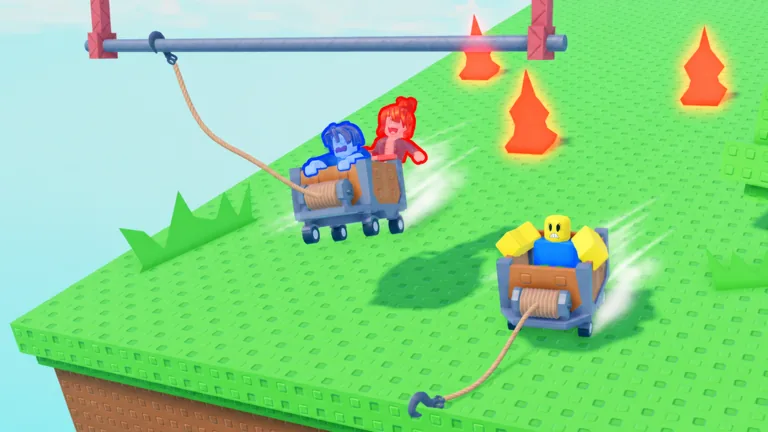
Choose the one-player option in the lobby and use the opening stretch to learn the cart at your own pace. A solo rider appears in the game images, and the title explicitly offers one-player play. You can practice the rope, landing, and recovery without waiting for a partner.
The useful difference from a shared ride is control over the pace of practice. No partner has to wait while you repeat one small section. That does not establish that the solo course is shorter, safer, or worth a different reward; check the live game before assuming any of those differences.
Test one control at a time
Start by reading the on-screen input hints. Move a short distance where you can still see the next edge. Then test the hook toward a visible structure. The cart’s rope spool and hook are clear in the official art, but the game’s public description does not publish an input map. A recorded player says to press E during a session; use that as a clue only if your own client shows the same binding.
For a clean test, ask yourself:
| Check | Useful answer |
|---|---|
| Did the rope visibly attach? | If not, change the target before changing speed. |
| Did the cart keep moving? | If yes, plan the landing sooner on the next try. |
| Can you see where the wheels will arrive? | If not, wait for a better camera angle before committing. |
Avoid assuming that a missed hook means the whole idea is wrong. It may be a poor target, a late input, or simply the wrong location to attempt the maneuver. Alter one variable on the next run.
Read the course from the cart’s position
The game images show a grassy platform, orange pointed objects, a blue ramp, and a cart over lava in a cave. They do not establish the order in which you encounter those scenes. Treat each as a separate visibility problem: where is the safe surface, where could the hook attach, and what happens if you keep rolling? Looking from the cart’s current position matters more than memorizing a promotional image.
At a gap, resist the urge to fire at the first dark shape above you. Check that your intended target is a real structure in the current level and that there is a landing beyond the gap. If you can test on a safer section first, do so. If the cart falls, use the displayed reset or respawn controls and return to that decision with one adjustment.
Move to duo only when you can explain your plan
You do not have to master solo mode before joining a friend. Still, one successful practice crossing gives you a useful language for duo play: “that support,” “fire after the ramp,” and “land on the far platform.” Those concrete callouts help more than “go now.” For shared-cart boarding and communication, use the two-player guide.
FAQ
Can I play Grapple Cart Obby by myself?
Yes. The official title explicitly names one-player play, and official art shows a solo rider.
Is solo mode a different map?
The available official page does not confirm a separate map. Compare the current lobby and first section in game before expecting a different route.
Do I need to know every control before moving?
No. Learn the current movement and hook inputs in a safe stretch, then add the next control when you need it.
What if my hook misses?
Check the target and your timing separately. A different target is more useful than repeating the same blind shot.
Will resetting keep my progress?
Check the game’s current checkpoint or respawn behavior. The official description does not specify progress saving.