![[1 & 2 PLAYER] Grapple Cart Obby Wiki logo](/images/site/logo.webp)
Make one decision at a time
Agree on the next move before either rider acts. One person can call the anchor and the other can watch the landing, but both should know when the cart will move. In a two-player run, calls to wait, shoot, turn, and reboard came quickly enough to show how easily a shared plan can fall apart.
Use a two-part callout: where, then when. Point out the intended structure or landing first. Once both riders are looking at the same place, call the moment to move. If the game assigns different actions to the seats, test the current seat prompts on a safe stretch. Do not assume that one person always drives and the other always fires the hook.
Give each rider a useful job
Roles do not need to be hard-coded by the game to help your pair. One person can watch the near edge and cart position. The other can watch the next possible anchor and landing. If both players can issue inputs, agree who will use the hook for the next obstacle and avoid two rushed commands at once.
| Situation | Short callout | Decision |
|---|---|---|
| Approaching a gap | “Target above, land right” | Both riders know the intended crossing. |
| Partner is not seated | “Wait, not aboard” | Do not launch yet. |
| The rope misses | “Reset the aim” | Change the target, not every input at once. |
| Another cart blocks the line | “Hold for space” | Keep a clear view of the landing. |
These are communication examples, not quoted in-game commands. Replace them with words your partner recognizes quickly. Long explanations are useful between attempts, not while the cart is rolling toward an edge.
Debrief a failed attempt in one sentence
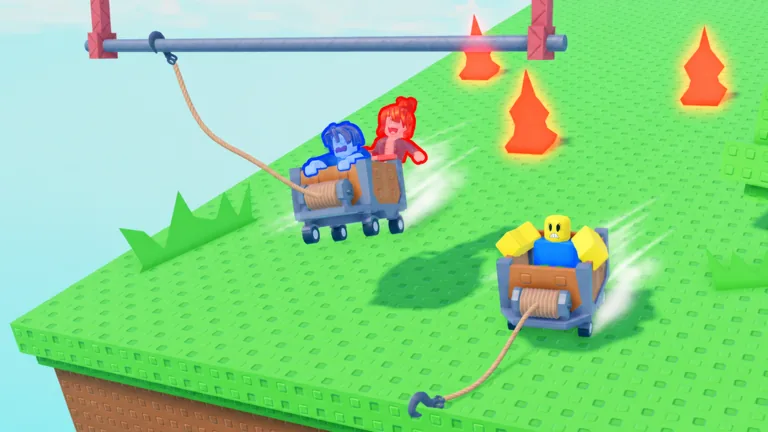
When a shared cart stops or falls, do not argue about who pressed what. Identify the visible failure: missed attachment, late timing, poor landing line, or partner left behind. Then choose one adjustment for the next run. The two-player session used for this guide contains several restarts and moments where the players disagree about steering; the fastest improvement is a clear shared plan before reboarding.
If the current game displays a reset control, use it together and meet at the next boarding point. If only one of you returns, wait. A solo player can continue alone, but that is a different run from the shared-cart attempt you planned.
For the boarding steps, see how to join a two-player cart. For the hook decision itself, see the grapple hook guide.
FAQ
Do two players have fixed driver and hook roles?
Check the seat prompts in your current client. The public game page does not publish a fixed role map.
What should we call out first?
Name the target and landing before calling when to move. That puts both riders on the same plan.
What if my partner fires too early?
Wait for the result, then agree on a later call for the next attempt. Avoid issuing competing inputs to correct it midair.
Should we keep moving after one rider resets?
Regroup before another shared run. Confirm both avatars are back in the cart before launch.
Is duo mode easier than solo mode?
The game page does not rank difficulty. Good communication can help, while poor timing can make a shared cart harder to manage.